
SciTechDaily - Particle-wave duality is one of the most mysterious facets of quantum
physics. It states that every quantum object has properties of both a
wave and a particle. This can be easily demonstrated using the
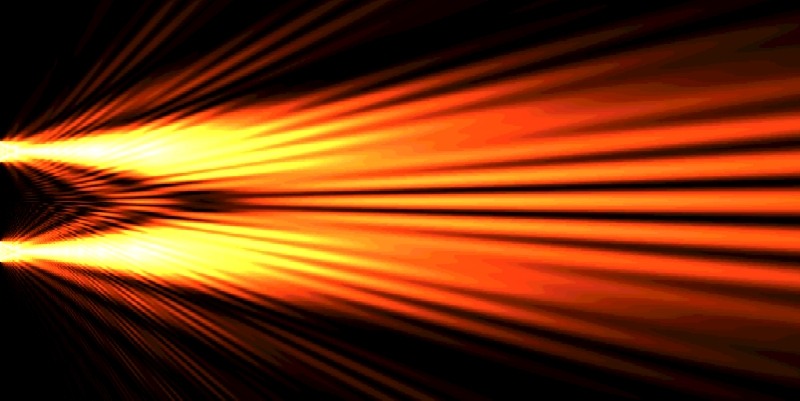
double-slit experiment. Streams of particles directed at a barrier,
facing the two narrow openings, create an interference pattern, as
though they are waves. Neither a pure wave nor particle description has
been able to successfully explain these experiments.
Researchers have now performed a quantum interference experiment with
magnitudes larger and much more massive molecules than used before. The
findings were published in the journal Nature Nanotechnology.

The experiment, where 100 atoms were launched at a barrier which was
designed to minimize molecular interactions, approaches the macroscopic
scale, delving into an area where macroscopic and quantum physics
overlap. This offers scientists a way to study the transition that has
been frustrating to explain.
In quantum physics, the wavelength of a massive particle is inversely
proportional to its momentum since the mass is multiplied by the
particle’s speed. The heavier an object, the shorter its wavelength at a
given speed.
Longer wavelengths make it easier to generate interference patterns. The large pthalocyanine (C32H18N8) molecule and its derivatives (C48H26F24N8O8)
have more mass than any others that have produced observable patterns
of quantum interference. The molecules needed to move slowly to produce
interference. This was accomplished by directing a blue diode laser onto
a thin film of molecules in a vacuum chamber, boiling off individual
molecules directly under the beam, leaving the rest undisturbed.
When they started the experiment, individual light spots started
appearing in the fluorescent detector. Over time, these spots formed an
interference pattern due to the wavelike character of the molecules.
Future experiments with even larger molecules might be able to
examine the exact transition between macroscopic physics and quantum
physics, providing insight into a grand unified theory of physics.


No comments:
Post a Comment